
Disaster and Development Organization (DADO)
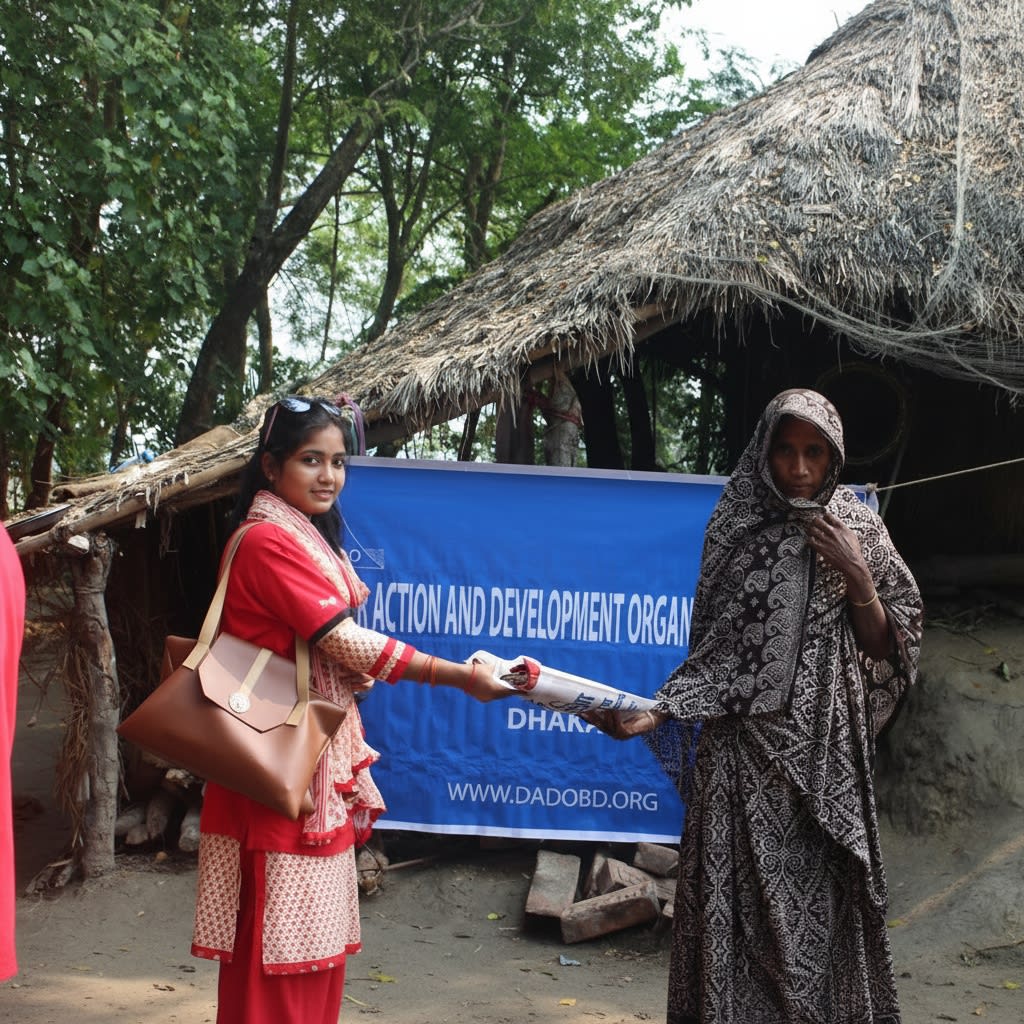
Since 2008, DADO serves the most marginalized in remote, disaster-prone lands. We go where the need is greatest to save lives.
Since 2008, DADO serves the most marginalized in remote, disaster-prone lands. We go where the need is greatest to save lives.






Disaster and Development Organization (DADO)
Our Mission
Our mission is to protect lives and livelihoods in disaster-prone communities, prioritizing the poor, marginalized, and disabled, while transforming outcomes through research, innovation, advocacy, and action—driving lasting change and influencing policies where it is needed most.
The Need
Approximately 97% of land and 98% of 177 million people in Bangladesh face multiple hazards. Despite widespread efforts, few reach the most vulnerable in remote, high-risk areas; Disaster and Development Organization (DADO) delivers impact where it matters most—your support can change lives.
The Solution
DADO reaches the most disadvantaged in remote, high-risk disaster areas—delivering education, resilient housing, child protection, sustainable livelihoods, and health programmes. Your support enables life-saving impact where others cannot reach.
Our impact
Since 2008 we reached over 1.1 million disadvantaged population in Bangladesh. The DADO fostered an inclusive and resilient society by strengthening the capacity of individuals, professionals and communities living in high-risk areas to cope better with disasters and advance resilient development.
About DADO
Established in 2008, the Disaster and Development Organization (DADO) is an independent, non-profit institution that specializes in policy analysis, action research and project implementation for disaster risk reduction, climate change adaptation, public health and sustainable development. DADO's work encompasses the interdisciplinary field of sustainability science, focusing on the intricate interplay between environmental preservation, societal well-being, and economic equilibrium. It’s niches on disaster and development nexus that disaster events undermine development gains and development reduces the effect of disaster. In these contexts, unilineal disaster risk reduction approaches often fail due to fragmentation, individual knowledge, lack of coordination, leadership, resources, institutional support and cost inefficiency. The solution is seen as a holistic societal, state, private and third sector approaches that can integrate multi-hazard and development planning processes together. The DADO aims to prepare an inclusive resilient society through building capacity of the individual, professionals and communities living in at-risk areas to cope better with disasters and achieve sustainable development.
DADO's work is guided by three foundational principles:
Activities achieved between 2023 and 2025 are provided below:
2025
• World Drowning Prevention Day 2025 observed in Sandwip on 25 July 2025
• DADO interns undertake four weeks’ social media campaign on the observance of World Drowning Prevention Day 2025.
• DADO Summer 2025 Internship project supported 25 interns from seven major public and private university graduates who worked on fire incidences, drowning prevention, traffic incidences, drought and community violence in Bangladesh.
• Waste management in Cumilla in association with Cumilla waste management system in June 2025.
• Alam E, Al Hattawi KS, Akter H, et al. 2025. Socioeconomic, demographic and environmental factors of child drownings in Northern Bangladesh, Injury Prevention, 0:1–10. doi:10.1136/ip-2024-045434 (Research Article)
• Perceptions of climate change and its Impacts on local communities along the Noakhali Coast in Bangladesh (Research article)
2024
• Rescue and relief operation in Flash flood in August 2024 in Fatikchari, Chhattogram.
• Courtyard meetings to generate awareness in Maghdhara, Haramia and Rahmatpur unions in Sandwip led by the Volunteers of DADO and the research students of the Department of Geography and Environmental Studies, University of Chittagong, Bangladesh in May 2024.
• Training volunteers and leaders of Sandwip Youth Club Chittagong about the importance of inclusion of child drowning prevention on their annual agendas on 7 March 2024.
• Child drowning baseline survey among 16500 households in Sarikait and Maitbanga unions in Sandwip, Chittagong, Bangladesh between January and February 2024.
• Child drowning baseline survey among 18 004 households, comprising 71 185 people, in 2 unions in Northern Bangladesh between January and February 2024.
2023
• Courtyard meetings to raise awareness about child drowning prevention in Sarikait union, Sandwip, Chittagong, Bangladesh on 22 December 2023.
• The necessity of civil society engagement in child drowning prevention in partnership with Rotary Club Baridhara at Hotel Westin, Gulshan-2 Dhaka, Bangladesh in 2023.
• The necessity of civil society engagement in child drowning prevention in partnership with Rotary Club-Sagorika, Chattogram, Bangladesh in 2023
• The necessity of civil society engagement in child drowning prevention in partnership with Rotary Club of Royals, Chittagong, Bangladesh in 2023.
• Childhood Drowning Prevention through Awareness, Action and Development (DAAD) in Bangladesh’ (Awareness and capacity development event organized at Upazila complex in collaboration with Sandwip Upzila Administration, Chittagong) on 25 July 2023
• Childhood Drowning Prevention through Awareness event organized at Kazi Afaz Uddin High School in collaboration with Sandwip Janokallan Sangstha July 2023
• Childhood Drowning Prevention through Awareness event organized at Shiber Hat in Sandwip in collaboration with Sandwip Janokallan Sangstha July 2023
• Childhood Drowning Prevention through Awareness event organized at Sarikait Union Parshad Office at Sandwip Upazila in July 2023.
• Rising child drowning deaths - a neglected national crisis (Editorial Daily Ittefaq on 20 July 2023)
• Factors of cyclone disaster deaths in Bangladesh (Published Research Article)
• Modified Mercalli Intensity Map in Bangladesh: a proposal for earthquake zoning in Bangladesh (Published Research Article)
• Enhancing Effectiveness of Occupational Health and Safety of Garments and Textile Industry Workers in Chittagong, Bangladesh (Published Research Article)
A sample current project: Child drowning prevention in Bangladesh
Child drowning remains a critical yet under-recognised public health crisis in Bangladesh. According to the Bangladesh Health and Injury Survey (2023), approximately 18,268 children aged 0–17 years die from drowning each year, equivalent to 50 deaths every day, and exceeding mortality from pneumonia, malnutrition, and diarrhoea combined (WHO, 2025). The risk is most severe in rural regions, where children play or bathe near unprotected ponds and canals.
Field research by the Disaster and Development Organization (DADO, 2024) in Sandwip Island—one of the most hazard-prone areas—revealed that over 96% of drowning incidents occurred in household ponds used for bathing and washing. Alarmingly, 80% of cases happened within 20 metres of the home. Women, as primary caregivers, are frequently blamed for these deaths, despite limited access to childcare, economic insecurity, and lack of training in drowning prevention. These findings are consistent with those of studies conducted in other regions of Bangladesh (Hossain et al., 2022; Alam et al., 2025).
Evidence further shows that over 80% of rescued children receive incorrect treatment due to poor first aid knowledge. While drowning is preventable, community-level awareness, first response capacity, and coordination among sectors remain weak. Local responses are further weakened by widespread beliefs and myths which attribute children’s drowning to evil spirits, or water goddesses, or because someone (e.g. mother) was bewitched (Blum et al., 2009). The World Health Organization (2025) identifies six proven drowning prevention measures, including supervision, education, swimming instruction, and cardiopulmonary resuscitation (CPR) training. Bangladesh’s National Drowning Prevention Strategy 2025 outlines broad national actions but lacks local-level integration with ongoing programmes such as cyclone preparedness and rural development initiatives. This project addresses these gaps by enhancing cognition and first response skills through community-based education, first aid and CPR training, and policy linkages to strengthen cross-sectoral collaboration for sustainable drowning prevention in Bangladesh.
Future projects by DADO:
• Child drowning prevention: awareness, water safety, first aid, and early child care
• Resilient housing: low-cost, disaster-resistant homes for ultra-poor families repeatedly displaced
• Sustainable livelihoods: income support for disaster-affected communities
• Health promotion: essential services for the extreme poor in high-risk areas
• Education: support for underprivileged children in coastal and riverine communities
• Water and sanitation: facilities for vulnerable single mothers
• Multi-hazard risk reduction across Bangladesh

I wish all the best.