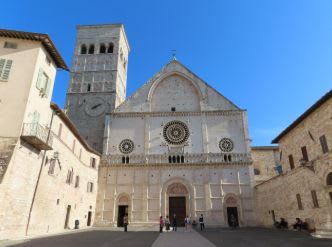



History:
Built in 1029, the cathedral was given cathedral status in 1036
Rebuilt in 1140 and consecrated in 1253
The cathedral's interior was modified in the 16th century
Features:
Romanesque façade that's considered one of the greatest examples of Romanesque art
Baptismal font where Saint Francis, Saint Clare, and possibly the future Emperor Frederick II were baptized
Chapel of the Blessed Sacrament decorated in a Baroque style
The remains of St. Rufino, the first bishop of Assisi, are buried in the crypt
Significance:
St. Rufino was martyred in the 3rd century
He was thrown into a river, weighted down by a stone which was tied around his neck
St. Rufino is the patron saint of Assisi
The Cathedral of San Rufino in Assisi is the main place of Catholic worship in the city of Assisi, the mother cathedral church of the diocese of Assisi - Nocera Umbra - Gualdo Tadino. The church stands in the square of the same name, originally a terrace created in Romans times, perhaps the forum of the roman city od Asisium. Medieval historians indicate that of a roman temple dedicated to the Bona Mater. San Pier Damiani wrote that on this site there had been a basilica with the remains of San Rufino since 412 and how the bishop Ugone (11th century) was in confit with the people because he wanted to move them to the cathedral of Santa Maria Maggiore, with the victory of citizens of Assisi.
Estimate for the Conservation Restoration
of the Terracotta Altar Surround and the Cover of the Baptismal Font
Cathedral of San Rufino in Assisi (PG)
HISTORICAL AND ARTISTIC CONTEXT
The terracotta altar structure framing the baptismal font is configured as a complex architectural-sculptural structure, developed predominantly in height, characterized by relief-decorated surfaces and three-dimensional plastic elements.
The decorative apparatus includes fully three-dimensional figures depicting iconographic symbols of the Evangelists, inserted within an articulated decorative scheme of strong celebratory significance.
The work can be traced to an intervention aimed at enhancing the baptismal area, plausibly datable to the second half of the 19th century, in connection with Franciscan commemorations. This chronological attribution, while requiring further archival research and material analysis, is nevertheless consistent with:
the execution techniques employed;
the plastic language of the figures;
the extensive use of decorative terracotta, typical of late-19th-century production.
STATE OF CONSERVATION
Following preliminary observations, the work presents the following conservation issues:
widespread deposits of incoherent particulate matter;
darkening and superficial patinas of mixed nature;
residues of undocumented previous treatments;
structural losses;
presence of fragmentary decorative elements.
In particular, original fragments pertaining to the sculptural element symbolizing the Evangelist Luke, located on the right base, have been identified.
At present, no structural instability is detected; however, a marked surface chromatic shift is evident, attributable to oxidation of applied substances, plausibly applied during the course of the last century.
The presence of a heavily oxidized patina, not original to the work dating to the late 19th century, can presumably be traced back to maintenance interventions carried out in the second half of the 20th century.
INTERVENTION METHODOLOGY
Preliminary investigations
high-resolution photographic documentation before intervention;
mapping of the state of conservation and deterioration;
preliminary cleaning tests on sample areas;
verification of ceramic material cohesion.
Cleaning
Cleaning will be carried out gradually and selectively through:
removal of incoherent deposits using soft brushes and controlled suction;
cleaning with demineralized water and inert supports;
mild use of solvents, subject to authorization by the High Supervisory Authority and compatibility with public access to the site.
Consolidation
Consolidation will address decohered and micro-cracked surfaces through:
impregnation with low-viscosity consolidants specific to terracotta;
localized application on three-dimensional elements and fully sculpted figures;
absorption control and effectiveness verification.
Final protection
In agreement with the Works Directorate, the advisability of applying a suitable breathable protective coating will be evaluated to reduce moisture absorption and particulate deposition.
CONSERVATIVE INTERVENTION ON THE BRONZE AND GLASS COVER OF THE BAPTISMAL FONT
The baptismal font, located in the Basilica of San Rufino, is an element of significant historical and liturgical value. Made of granite, it presents a monolithic structure, protected by a wrought-iron decoration and a cast bronze cover decorated in relief with phytomorphic motifs.
The cover of the font, made of copper alloy and glass with a central book-style opening, is configured as a Greek cross framed by an egg-and-dart decorative band outlining the basin. Tradition associates this font with the baptisms of Saint Francis and Saint Clare, making it a central element in the historical narrative of the cathedral.
State of conservation
The surface of the cover shows incoherent dust deposits and surface chromatic alterations attributable to previous interventions. In recessed areas, residues of cleaning products are evident. The surface patina appears thinned, particularly on the decorative relief surfaces of the central cross.
Purpose of the intervention
The intervention aims to:
remove superficial incoherent deposits;
preserve the bronze elements by removing active corrosion products and stabilizing the metal structure;
ensure long-term durability through protective treatments compatible with the original materials.

Donors
Donald Fischbeck My wife Monica and I are parishioners of San Rufino and attend daily Mass. This is the best way to support a church where Saint Francis preached and was also baptized.
Louis Brown Thank you for the opportunity to support the restoration of this part of St. Francis and St. Chiara’s legacy!
Noel KENT