Friends of Tendo Social Development Diaspora Fund logo

Friends of Tendo Social Development Diaspora Fund

Turning banana waste into sustainable products that reduce reliance on plastics and create livelihoods for women and youth.
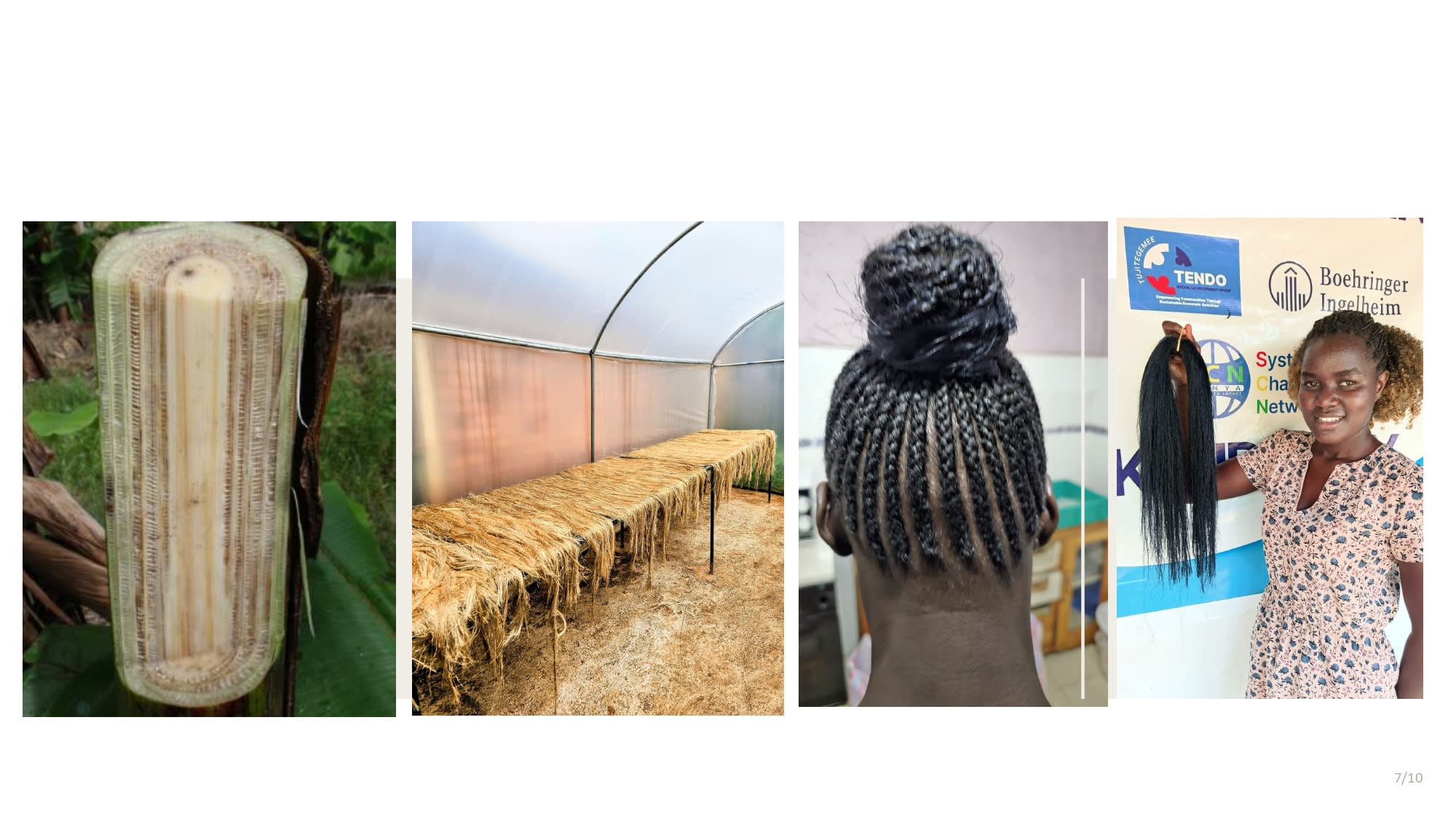
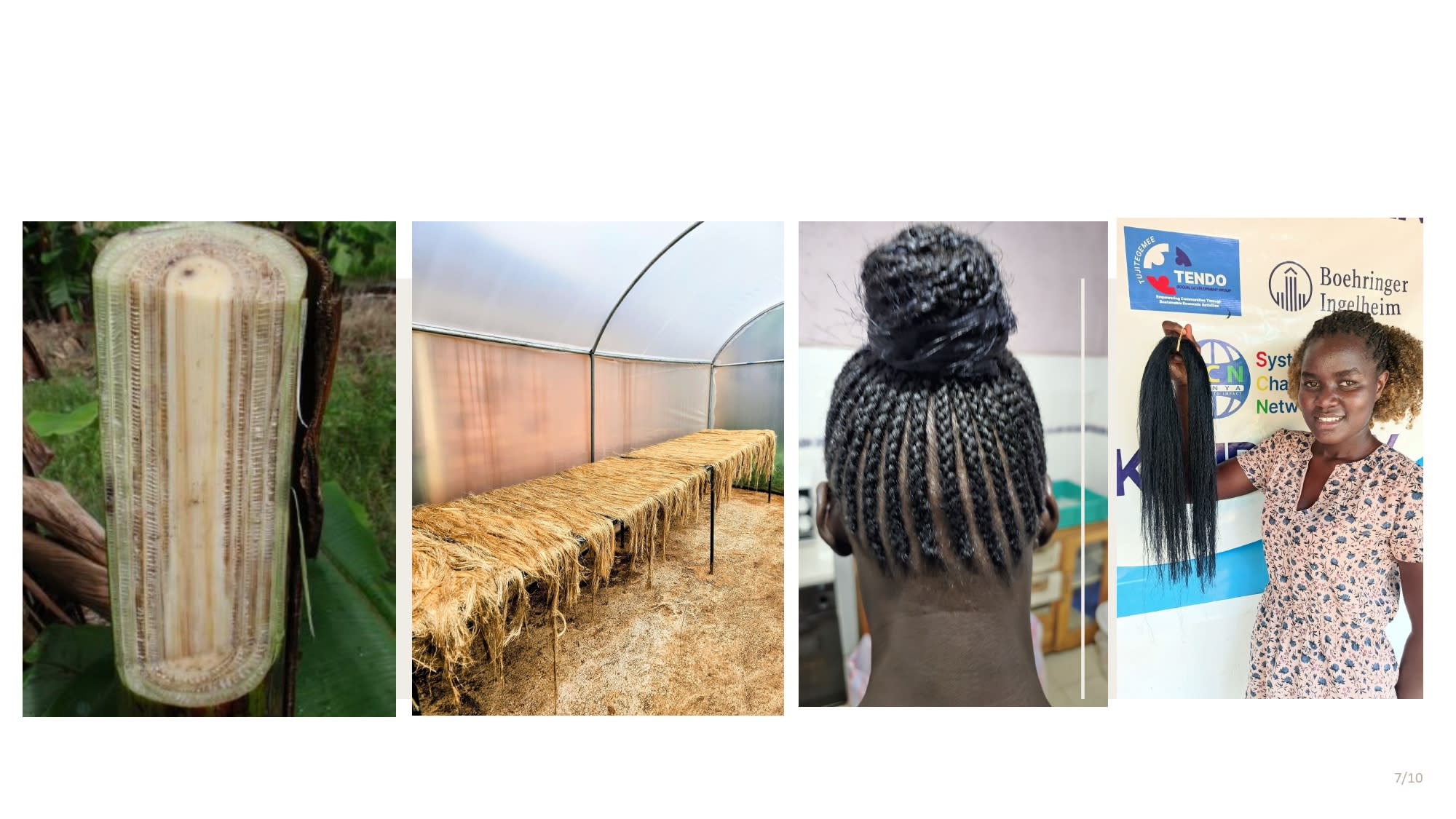
Yes—this hair extension was made from banana fibre in Kenya.

Tendo Social Development Group

What if agricultural residue could replace synthetic materials, create livelihoods and give young people more choices about their future?

That question captures what Tendo Social Development Group is working to achieve in Kenya.

Tendo is a Kenyan nonprofit creating sustainable livelihood opportunities for women and young people, particularly in communities where unemployment and limited economic opportunities can make migration feel like the only path to a better life.

Our belief is simple: “The grass can be green here.”

We do not seek to discourage migration. We want women and young people to have genuine economic choices—whether they choose to build a livelihood in their community, move elsewhere in Kenya, or migrate internationally.

From banana residue to beautiful hair

One of Tendo's most exciting innovations began with something normally left behind after a banana harvest: the banana pseudostem.

We are developing fibre extracted from these pseudostems into natural hair extensions. This creates the potential for a new circular value chain:

BANANA FARMERS → FIBRE → WOMEN & YOUTH → NATURAL HAIR EXTENSIONS → BRAIDERS & SALONS → CONSUMERS

Following six months of research and development, Tendo has produced a functional, wearable banana-fibre hair extension. Prototypes have been worn and tested by women and have also been worked with and evaluated by professional braiders.

The next challenge is to move from a successful prototype to a consistent, market-ready product.

The environmental opportunity is compelling. Conventional hair extensions rely heavily on synthetic materials. We want to establish how far renewable banana fibre can substitute for these materials while creating productive value from agricultural residue left after the fruit has been harvested.

We are deliberately taking an evidence-based approach. Rather than simply describing the product as “green,” “plastic-free” or “biodegradable,” we want to measure and validate its environmental performance—including synthetic-material substitution, banana-residue utilisation, water and energy use, waste recovery, durability and end-of-life options.

One innovation. Multiple opportunities.

For banana farmers, fibre could create an additional source of value from the banana plant after the fruit has been harvested.

For women, opportunities can extend across fibre preparation, treatment and finishing, production, quality control, packaging, distribution, braiding, salon services and enterprise.

For young people, the emerging value chain can create opportunities in processing, production, technology, logistics, digital marketing, sales and entrepreneurship.

For the environment, the innovation gives us an opportunity to demonstrate whether an agricultural residue can become a commercially useful renewable material that reduces reliance on conventional synthetic fibre.

And for communities, viable green enterprises can expand the economic choices available to people who might otherwise migrate primarily because they see few livelihood opportunities closer to home.

Creating livelihoods. Expanding choices.

Tendo's work goes beyond banana fibre.

From our programmes in Kendu Bay in Homa Bay County and Mukuru in Nairobi, we work with women and young people to develop practical pathways to income through enterprise development, agripreneurship, climate-smart agriculture, production and sales.

We are also working with partners to help young women make safer and better-informed decisions about migration—understanding their rights, assessing risks, comparing the true financial implications of different opportunities and considering viable livelihood pathways closer to home.

Across these activities, our purpose remains the same:

Create livelihoods. Expand choices. Strengthen communities.

What your donation can make possible

Your support can help us take our banana-fibre innovation from successful R&D to market readiness.

Donations can contribute to product refinement and quality testing; improved fibre processing and pilot production; building a reliable supply chain with banana farmers and cooperatives; expanded testing with consumers, braiders and salons; environmental measurement and validation; more efficient use of water and energy; and preparing women and young people to participate in the emerging value chain.

We believe environmental innovation becomes even more powerful when it also creates economic opportunity.

A banana plant can create value beyond its fruit. Agricultural residue can become a resource. Women and young people can participate in a new green value chain. And migration can become a choice rather than a necessity.

Help us turn agricultural residue into opportunity—for people and for the planet.

Kenya
tendo.co.ke
Myriad USA logo
Friends of Tendo Social Development Diaspora Fund is hosted at Myriad USA

Fundraisers

Feed fundraiser card link to KNOSK Charity Education Initiative Diaspora Fund
Friends of Tendo Social Development Diaspora Fund logo
Official fundraiser

KNOSK Charity Education Initiative Diaspora Fund

KNOWK Charity Education Initiative is providing access to quality education to poorest and out-of-school children in Kuje community Abuja, Nigeria, through the KNOSK 100 Naira /6cents A-Day Charity Secondary School, which was Cofounded by Irene Bangwell, an educationist, girls coach and an author, and an ASHOKA Fellow, Kingsley Bangwell, in 2019 in Kuje community, Abuja Nigeria. The Big Urgent Problem Millions of secondary school students from poor households and communities in Nigeria, especially girls do not complete secondary school, and are out of school. For instance, 55% of girls and 43% of boys from poorest families do not complete secondary school in Nigeria. (Ministry of Education, Nigeria) Secondly, there is huge education and learning inequality, because data shows that poor children get about 19.7% learning compared to 79.4% that child from middle- and upper-income class get in Nigeria, alarming. Without access to quality education, millions of today’s teenagers with huge potentials and bright future will end up uneducated, unfulfilled, poorly skilled, unable to unlock their creative potentials. If they are girls will risk child-marriage and health challenges, become uneducated mothers and unable to read basic medical prescription or support schooling of the next generation of girls, thereby continuing another generation of poverty. If boys, many will join gangs and violent groups and arrive the future without skills for decent jobs and sustainable livelihood. Alternatively, if we can equip them with education and skills, they will create great enterprises, innovations, be productive employees, pay taxes and contribute to just, fair and prosperous societies. We can save the next generation from poverty and put them on the pathways of productivity and prosperity, one child at a time and at scale! This is why we established the KNOSK Charity School Kuje. Vision A future where today’s out-of-school children become highly skilled and innovative young people; developing, transforming, and prospering our nations. Mission Providing access to quality and skills-based secondary school education to children from the poorest households and out-of-school children, to enable them to transition from generational poverty to a future of prosperity Our Uniqueness For N100/6Cents A-Day, students get uniform, sportswear, books, lunch, monthly sanitary pads for girls and STEM -based education. It is practically easier to start school at KNOSK than a public government school in the community due to financial barriers government schools present in the name of levies.
Donate
Feed fundraiser card link to Friends of PEDN Network Diaspora Fund
Friends of Tendo Social Development Diaspora Fund logo
Official fundraiser

Friends of PEDN Network Diaspora Fund

The Private Education Development Network (PEDN) is a Ugandan non-profit organization established in March 2004 that focuses on empowering young people through entrepreneurship and financial education. PEDN works with a public private sector ecosystem so that the gaps in the Education and Economic sector are solved using a collaborative systems approach. Vision and Mission: Vision: A Ugandan society that is enterprising and productive. Mission: To empower young people in Uganda through innovative and demand-led entrepreneurial interventions that enable them to transform their livelihoods and communities. Strategic Mission Statement: To facilitate the development of young people's creative and innovative potential by equipping them with basic entrepreneurial, financial, business, and personal development skills in an open and collaborative environment. Core Values: PEDN operates based on several key principles to guide its educational and community interventions: • Teamwork • Transparency • Professionalism • Accountability • Productivity • Creativity Why PEDN: The Private Education Development Network (PEDN) was established to address several critical gaps in the Education landscape as follows: • Challenge Rote Learning: The organization was formed to challenge the traditional education system that prioritized passing examinations over practical skill acquisition. • Addressing Youth Unemployment: It aimed to shift the focus from producing "job seekers" to "job creators" by equipping youth with market-led vocational and business skills. • Integrating Entrepreneurship and Financial Literacy: It sought to promote and integrate entrepreneurial teaching and financial education into both formal and informal education systems in Uganda through "Young Entrepreneurs" clubs. • Curriculum Reform: It was created to serve as a catalyst for advocacy, lobbying the National Curriculum Development Center (NCDC) to mainstream entrepreneurship and financial inclusion into the national education curriculum. • Filling Skill Gaps: PEDN created new learning spaces for practical, interactive activities designed to enhance life skills, personal awareness, and workforce readiness. • Competency-Based Learning: PEDN promotes new teaching pedagogies that extend learning "beyond the four walls of the classroom," prioritizing critical thinking and problem-solving skills essential for social innovators. • Curriculum Mainstreaming: PEDN lobbies the National Curriculum Development Center (NCDC) and the Ministry of Education and Sports to integrate social entrepreneurship and financial inclusion into the national education curriculum. • Defining the Field of Social Entrepreneurship: The organization actively promotes the concept of social entrepreneurship as a "smart utilization" of money and the environment to solve social problems rather than just maximizing profit, through innovation hubs. • Digital Transformation: Recent initiatives, such as the 10X Program, focus on "digitalizing women agribusiness" in Eastern Uganda, using technology as a tool for social and economic inclusion. • PEDN serves as a primary vehicle for the "Everyone a Changemaker" vision in Uganda by replicating the Ashoka Youth Venture framework: • Social Innovation: PEDN’s curriculum mirrors the four core "changemaker skills" advocated by Ashoka: Empathy, Collaborative Leadership, Fluid Teamwork, and Changemaking. • Mentorship, Coaching and Networking: Following the Youth Venture model, PEDN connects students with adult mentors and business professionals to refine their ideas and build "teams of teams"
Myriad USA logo
Friends of Tendo Social Development Diaspora Fund is hosted at Myriad USA

Become a supporter!